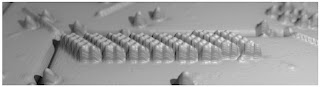
Not much smaller than that

Making things smaller is one of the important things that we do with nanotechnology.  Making transistors (those little switches that make up computer chips) smaller has been going on since they were first discovered 50 years ago.  Now scientists in Australia and the United States have made a transistor out of a single atom.  Yup a single atom.  The start by  digging a trench and then putting in just one atom of phosphorus.  Yup a single atom. 
http://preview.tinyurl.com/7bhhgow

Kaboom!

Dust is not only an annoyance gloaming on to stuff and making us sneeze.  It can be dangerous if it gets into the air and there is a lot of it.  At the nanometer scale, things are different and things that can burn---burn a lot faster.  It is the way the engine in a car works, tiny droplets of gasoline burn really fast in the cylinders of the engine.  Even things as innocent as sugar can become explosive if tiny particles become airborne.  Now scientists have shown that nanodust is even more explosive than just regular dust.  As the size of something is reduced its surface area gets larger.   It takes a lot less energy to ignite the material and so it can be made to burn a lot easier.  Nobody is sure if this makes the manufacturer of nanomaterials more dangerous but for the past few hundred years the dangers from exploding flour in mills has been well known.
read more

Itty bitty bit

Scientists at IBM report that they are able to store data on the smallest set of atoms ever.  They can store a bit of data on just 12 atoms.  Probably not ready for your thumb drive (or even your pinkie drive) this new approach will still lead to revolutionary ways of thinking about storing data.  The new approach uses an antiferromagnetic structure which means the atoms point in opposite directions.  Because of that they can also pack a lot more of them together.  The work uses the scanning tunneling microscope which was invented at IBM 30 years ago and used to create the famous IBM logo spelled out with just 35 atoms.
http://tinyurl.com/87p5hfn

All we need are nano-hamsters

This showed up on one of the nano RSS feeds.  It has nothing to do with nano but it is funny and clever.  In the quest for renewable energy why not harness the energy hamsters expend running around their wheels.  There are hamster-powered floor cleaners, nanogenerators and my favorite a hamster-powered submarine.  It isn't exactly clear how much you have to feed the hamster and how much energy you get, but they are cute.
 http://tinyurl.com/6uu5cjz

A dog's best friend

Right! Man's best friend, the dog, now has his/her own best friend, 'Dirty Dog, Door Mat'.  A nanotech inspired product that according the manufacturer:
"Dog Gone Smart's Dirty Dog Doormat is based on its Advanced Microfiber Technology that entraps dirt, mud and water immediately. The doormat made of microfiber strands provides a super-sponge effect. It can soak up to seven folds of its mass in water and mud and dries five folds quicker when compared to the other doormats. The machine-washable doormat finds application in water and food bowls, under litter boxes, crates and cars."
arrrfff!
http://www.doggonesmartbed.com/

Paint your house in sunshine

Solar panels are pretty common and you find them on houses on top of building all trying to capture a bit of sunshine and make some electricity.  Now some research is suggesting that you can make paint that is able to do the same thing as solar panels---generate electricity.  The work from University of Notre Dame is just beginning and the paint is about 10 times less efficient than solar panels but it is a start. They used tiny particles of titanium dioxide (the same stuff as in most white paint) and coated them with cadmium salts that help convert the sunlight into electricity. 

See more at http://tinyurl.com/82yk95b

Nanooze Labs opens at Disneyland

On the West Coast and needing your Nanooze fix?  Stop by Nanooze Labs in Disneyland!  This new 1500 square foot exhibit features, RopeScope, Zoom and Touch a Molecule.  Located within Innoventions in Tomorrowland at Disneyland in Anaheim CA,  Nanooze Labs is a fun spot to hang out, explore, watch some outstanding videos and even pick up a copy of the magazine Nanooze.  Nanooze Labs is celebrating the International Year of Chemistry and will be on display till September 2012.

Your nano-Benz

NANOSLIDE coating on a Mercedes Benz engine
Sure maybe it is your grandfather's car.  But Mercedes Benz is now nano.  Not a nano car but has a nanomaterial.  NANOSLIDE technology involves spraying a thin layer of carbon and iron 'wires' on the cylinder surfaces inside of the engine.  How thin?  About 100 micrometers or 100,000 nanometers.  The NANOSLIDE surface looks shiny but it has tiny pores that trap enough oil to lubricate the surface.  The technology reduces the engine weight by 4.3 kilograms which they say saves 3% on fuel consumption.