
At the Materials Research Society December 2008 and April 2009 meetings, the popular "Science as Art" competition yielded some amazing images from the fields of nanotechnology. Some of prize winners include:
1. The Nano Teddy Bear which shows zinc oxide nanostructures deposited on an indium oxide coated glass substrate using an electrochemical deposition technique.
2. Carbon NanoEden
3. Nano Spaghetti and Meatballs where the 'spaghetti' is a collection of electrodeposited gold nanowires and the 'meatballs' are silicon nanoparticles.
4. Nanoflower made of crystalline wurtzite indium nitride made using a molecular bean epitaxy process.
5. The Nano-Grip composed of thick epoxy crystals self-assembled onto a 2.5 micron polystyrene sphere.
6. Modern Stonehenge consists of silicon nanopillars created using gallium implantation and deep reactive-ion etching.
Source: Nanowerk


 CryoEM can be used to look at the structure of a 7 nm self-assembled DNA tetrahedron, which is an incredible achievenment for scientists. Never before has such a small biological molecule been looked at with such high resolution!
 Let this new crawling vacuum introduced by Panasonic do all the dirty work! It's called Fukitorimushi, which means "Wipe-up Bug" in japanese. Working with textile maker Teijin, they have developed an autonomous floor-cleaning robot that crawls around like an inchworm. The robot is covered in a super-absorbent polyester nanofiber cloth that picks up microscopic dust and residue that ordinary vacuums leave behind.
 For the cathode, these genetically engineered viruses are built to coat themselves with iron phosphate, then self-assemble onto carbon nanotbues to create a network of highly conductive material. These viruses are a common bacteriophage, which infect bacteria but art harmless to humans.
 Scientists have developed special polymer films to improve the transfer of the fingerprint from the crime scene surfaces to the laboratory. This new polymer is conjugated with highly fluorescent particles so that interaction with oil would cause swelling and increased fluoresence intensity. This allows fingerprints to show up more clearly. Below are two fluorescent images showing (a) a fingerprint transferred to a polymer film from a glass surface and (b) the same fingerprint image after digital contrast enhancement.
 Source:
  Carbon nanotubes are tiny hollow cylinders of carbon that are tens of thousands of times smaller than a human hair, but several times stronger and stiffer than steel. Interested in seeing more images?

 The material in the jaw tips of sandworms is even better than synthetic polymers. Though scientists have long studied the mechanical and structural properties of these jaws, the organic composition has previously been overlooked. Scientists are now interested in finding the organic composition and protein structures of the cutting edge of the Nereis jaw. They have found that zinc plays an important role in the mechanical properties of Nereis jaws, by binding to bundles of protein fibers rich in histidine (an important amino acid), and that removing the zinc decreases the hardness by over 65%.
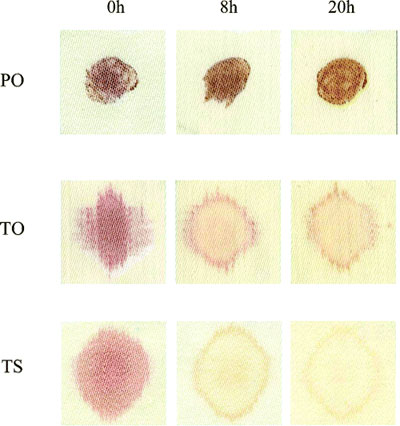 From Top to Bottom: Images of red wine stains on Plain Wool (PO), Wool coated with a generic stain-fighting chemical (TO), Wool coated with the new nanoparticle coating (TS) after 0, 8, and 24 hours under simulated sunlight.

 Researchers use a powerful microscope called an
  Researchers at Northwestern University have recently been able to create 3D structures from particles of gold by using
  Going where? Up the wall! The uncanny ability of geckos to climb shear walls has fascinated scientists for years. Researchers at the University of California - Berkeley, have developed an adhesive that mimics the easy attach and easy release of the reptile's padded feet. This new material is made up of millions of tiny plastic fibers that establish grip, and a mere square two centimeters on a side can support close to a pound! When the tape presses into a surface and slides downwards, it sticks. When the tape is lifted, it releases!
 The trick behind a gecko's speedy vertical escape has been exposed! The new material could prove useful for a range of products, from climbing equipment to medical devices.
 In today's high-tech world of Dysons and Roombas, how is a new vacuum going to stand out? Samsung is trying to appeal to the gaming crowd by designing a model that looks like the Master Chief character from the Halo universe.
 Scientists at Oak Ridge National Laboratory have used in situ time-lapse photography and laser irradiation to watch and record the growth of
  Researchers at Northwestern University have been studying how to use nanometer sized disks of gold and nickel to encrypt information. These nanodisks can form a pattern much like a barcode, which means that each pattern would have a unique response to a stimulus, such as electromagnetic radiation or light, depending on what type of molecule (or molecules) are attached to the disks. Their small size would also allow them to be invisible to the naked eye, and easily hidden in different materials or objects.
 How does nanotechnology help solve crimes? A revolutionary new technique developed by researchers in Israel now allows us to see hidden fingerprints more easily and quickly. Using gold nanoparticles dissolved in stable organic solution, fingerprints produced by the new solution are high-quality and can be developed just after three minutes. The gold nanoparticles stick to the fingerprint residues through hydrophobic interactions.