
At the Materials Research Society December 2008 and April 2009 meetings, the popular "Science as Art" competition yielded some amazing images from the fields of nanotechnology. Some of prize winners include:
1. The Nano Teddy Bear which shows zinc oxide nanostructures deposited on an indium oxide coated glass substrate using an electrochemical deposition technique.
2. Carbon NanoEden
3. Nano Spaghetti and Meatballs where the 'spaghetti' is a collection of electrodeposited gold nanowires and the 'meatballs' are silicon nanoparticles.
4. Nanoflower made of crystalline wurtzite indium nitride made using a molecular bean epitaxy process.
5. The Nano-Grip composed of thick epoxy crystals self-assembled onto a 2.5 micron polystyrene sphere.
6. Modern Stonehenge consists of silicon nanopillars created using gallium implantation and deep reactive-ion etching.
Source: Nanowerk


 Let this new crawling vacuum introduced by Panasonic do all the dirty work! It's called Fukitorimushi, which means "Wipe-up Bug" in japanese. Working with textile maker Teijin, they have developed an autonomous floor-cleaning robot that crawls around like an inchworm. The robot is covered in a super-absorbent polyester nanofiber cloth that picks up microscopic dust and residue that ordinary vacuums leave behind.
 The Monash's team of scientists are modeling the pizza toss mathematically, and have found that tossing pizza dough continuously without stopping to catch it requires your hands to move in circles. This model could help researchers design better ultrasonic motors, which operate on similar principles as pizza tossing. In the future, these tiny motors could be used in minimally invasive neuro-microsurgery procedures, giving surgeons more control and precision during brain surgery.
 For the cathode, these genetically engineered viruses are built to coat themselves with iron phosphate, then self-assemble onto carbon nanotbues to create a network of highly conductive material. These viruses are a common bacteriophage, which infect bacteria but art harmless to humans.

 At the University of Florida, researchers are training dogs to detect termites and bedbugs. Termites cause about $5 billion in damages every year in the U.S. and bedbug infestations have gone up 71% in the past 5 years. The dogs are trained using a combination of the U.S. Customs method and a food-reward system, and thus far, have an 96% accuracy rate with false positives of less than 3%.
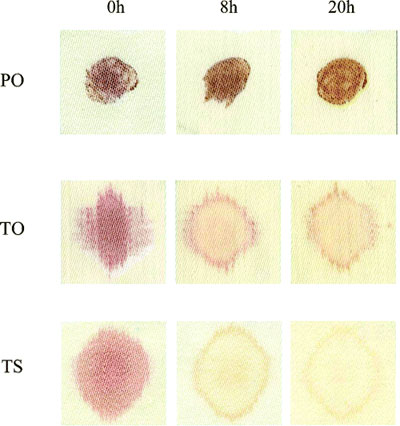 From Top to Bottom: Images of red wine stains on Plain Wool (PO), Wool coated with a generic stain-fighting chemical (TO), Wool coated with the new nanoparticle coating (TS) after 0, 8, and 24 hours under simulated sunlight.
 So how hot is hot? You can measure the heat of a chili pepper with your tongue, but how accurate is that? Everyone's definition of "hot" is different. Scientists are now using a new carbon nanotube-based sensor to quantify the "heat" of chili peppers.

 Going where? Up the wall! The uncanny ability of geckos to climb shear walls has fascinated scientists for years. Researchers at the University of California - Berkeley, have developed an adhesive that mimics the easy attach and easy release of the reptile's padded feet. This new material is made up of millions of tiny plastic fibers that establish grip, and a mere square two centimeters on a side can support close to a pound! When the tape presses into a surface and slides downwards, it sticks. When the tape is lifted, it releases!
 The trick behind a gecko's speedy vertical escape has been exposed! The new material could prove useful for a range of products, from climbing equipment to medical devices.
 In today's high-tech world of Dysons and Roombas, how is a new vacuum going to stand out? Samsung is trying to appeal to the gaming crowd by designing a model that looks like the Master Chief character from the Halo universe.
 How does nanotechnology help solve crimes? A revolutionary new technique developed by researchers in Israel now allows us to see hidden fingerprints more easily and quickly. Using gold nanoparticles dissolved in stable organic solution, fingerprints produced by the new solution are high-quality and can be developed just after three minutes. The gold nanoparticles stick to the fingerprint residues through hydrophobic interactions.
 We've seen nanotechnology being used in all sorts of fabrics for
  Maybe you've heard a lot about nanotechnology in the news but haven't actually seen any products available in the market. At the Consumer Electronics Show in Las Vegas, Planet82 displayed new prototype cameras called the "Nano-Cam".
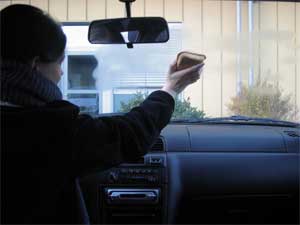 On cold winter mornings, when you first start driving, your vision is often blurred by moisture fogging up the windshield. This happens when warm, humid air from your car heater comes into contact with a cold surface. There is a particular temperature called the dew point where the moisture in the air condenses and forms a layer on the colder surface. This can be prevented by opening the windows, heating the entire car interior, or by just heating the windshield to a temperature above the dew point.
