... and what do I see? Bacteria! Pollen! Fungi! What's going on? A team of atmospheric chemists at University of California at San Diego have performed the first-ever direct detections of biological particles inside ice clouds. Taking samples of water droplets and ice crystal residues using a mass spectrometer while flying at high speeds through clouds in the skies of Wyoming, these researchers have revealed that the growth ice crystals were initiated almost entirely of dust or biological material, such as bacteria, fungal spores, and plant material.
 Though it has long been known that microorganisms become airborne and travel great distances, this is the first study that analyzes their influence on cloud formation. Researchers have found that the ice crystal residues were half made up of mineral dust and a third were made up of inorganic ions mixed with nitrogen, phosphorus, and carbon - the signature elements of biological matter.
If we can understand how these particles cause cloud formation, we can then determine the impact they have on the climate. For example, some scientists believe that the dust transported from Asia could be impacting the rainfall in North America!
Source: NSF Press Release 09-100


 The Monash's team of scientists are modeling the pizza toss mathematically, and have found that tossing pizza dough continuously without stopping to catch it requires your hands to move in circles. This model could help researchers design better ultrasonic motors, which operate on similar principles as pizza tossing. In the future, these tiny motors could be used in minimally invasive neuro-microsurgery procedures, giving surgeons more control and precision during brain surgery.
 For the cathode, these genetically engineered viruses are built to coat themselves with iron phosphate, then self-assemble onto carbon nanotbues to create a network of highly conductive material. These viruses are a common bacteriophage, which infect bacteria but art harmless to humans.
 Scientists have developed special polymer films to improve the transfer of the fingerprint from the crime scene surfaces to the laboratory. This new polymer is conjugated with highly fluorescent particles so that interaction with oil would cause swelling and increased fluoresence intensity. This allows fingerprints to show up more clearly. Below are two fluorescent images showing (a) a fingerprint transferred to a polymer film from a glass surface and (b) the same fingerprint image after digital contrast enhancement.
 Source:
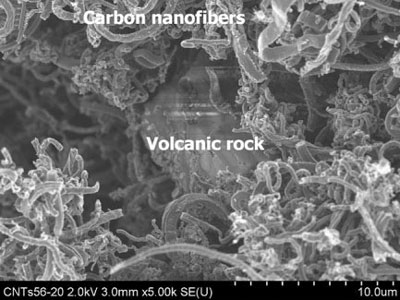
 Carbon nanotubes are tiny hollow cylinders of carbon that are tens of thousands of times smaller than a human hair, but several times stronger and stiffer than steel. Interested in seeing more images?