
For many, tattoos allow people to express their style. But did you know that in the near future, tattoos may become a means of treating disease? Diabetics who monitor their blood sugar levels often have endure many needle pricks every day. However, Heather Clark of Draper Laboratory in Massachusetts is developing a new tattoo ink that changes color based on glucose levels inside the skin. So how does it work? The dye is made up of tiny plastic nanoparticles. When the glucose is low, the particle is yellow and fluorescent, but when glucose levels increase, the fluorescence goes away and the particles turn purple. Though this tattoo would have to be periodically re-injected because it would shed along with the skin, it's a major step up from the daily needle pricks!
Scientists hope that this technology will be up and running in the next five to ten years.
Source: Earth and Sky
Nano Tattoo for Diabetics


My head is in the clouds...
... and what do I see? Bacteria! Pollen! Fungi! What's going on? A team of atmospheric chemists at University of California at San Diego have performed the first-ever direct detections of biological particles inside ice clouds. Taking samples of water droplets and ice crystal residues using a mass spectrometer while flying at high speeds through clouds in the skies of Wyoming, these researchers have revealed that the growth ice crystals were initiated almost entirely of dust or biological material, such as bacteria, fungal spores, and plant material.
 Though it has long been known that microorganisms become airborne and travel great distances, this is the first study that analyzes their influence on cloud formation. Researchers have found that the ice crystal residues were half made up of mineral dust and a third were made up of inorganic ions mixed with nitrogen, phosphorus, and carbon - the signature elements of biological matter.
If we can understand how these particles cause cloud formation, we can then determine the impact they have on the climate. For example, some scientists believe that the dust transported from Asia could be impacting the rainfall in North America!
Source: NSF Press Release 09-100
The Physics of Pizza Tossing
Interested in learning the art of a perfect pizza toss? Well, so are Monash University scientists who are studying the pizza toss in order to design the next generation of micro motors thinner than a single human hair. How does the dough travel through the air? How much does the dough rotate? How quickly does it spin? The Monash's team of scientists are modeling the pizza toss mathematically, and have found that tossing pizza dough continuously without stopping to catch it requires your hands to move in circles. This model could help researchers design better ultrasonic motors, which operate on similar principles as pizza tossing. In the future, these tiny motors could be used in minimally invasive neuro-microsurgery procedures, giving surgeons more control and precision during brain surgery.
Source: EurekAlert!
Image Source: Seattlepi.com
Harnessing the Power of Viruses
Researchers at MIT have genetically engineered viruses to build the positively and negatively charged ends of a lithium ion battery. With the same energy capacity and power performance as state-of-the-art rechargeable batteries, they could be used to power plug-in hybrid cars and a range of personal electronics. For the cathode, these genetically engineered viruses are built to coat themselves with iron phosphate, then self-assemble onto carbon nanotbues to create a network of highly conductive material. These viruses are a common bacteriophage, which infect bacteria but art harmless to humans.
Part of a recent wave of clean-energy technologies, these battery prototypes are lightweight, flexible, and pending commercial production.
Source: Eurekaalert
Who dunnit?
One of the most important clues at a crime scene investigation are latent fingerprints left behind by the criminal. No two fingerprints are alike - every individual has unique fingerprint ridges that do not change throughout one's lifetime. Over the years, forensic scientists have developed many ways to look at these fingerprints. Today, the most commonly used method is still fingerprint dusting where powder is spread lightly over a fingerprint surface using a brush, and clear tape is placed over the latent print in order to transfer and preserve the fingerprint pattern. Scientists have developed special polymer films to improve the transfer of the fingerprint from the crime scene surfaces to the laboratory. This new polymer is conjugated with highly fluorescent particles so that interaction with oil would cause swelling and increased fluoresence intensity. This allows fingerprints to show up more clearly. Below are two fluorescent images showing (a) a fingerprint transferred to a polymer film from a glass surface and (b) the same fingerprint image after digital contrast enhancement.
 Source: Chemical Communications
Image Sources: Teachcops Chemical Communications
Nano-Obama
At the University of Michigan, professor John Hart has used nanotechnology to create images of Barack Obama, the next president of the United States. Each Obama face is made up of 150 million vertically-aligned carbon nanotubes grown at really high temperatures and imaged with a scanning electron microscope. Carbon nanotubes are tiny hollow cylinders of carbon that are tens of thousands of times smaller than a human hair, but several times stronger and stiffer than steel. Interested in seeing more images? Click here! And, read about how they are made here! Apparently, there have been no nanoMcCains made as of yet....
Source: Nanotechnology Nanobama
Stained Glass Purifies Air
A team of experts at Queensland University of Technology have found that stained glass windows - the ones painted with gold - help purify the air when lit up with sunlight. People in medieval times were already using nanotechnology to produce colors with gold nanoparticles of different sizes. Numerous church windows across Europe were decorated with glass painted with gold nanoparticles. For centuries, people have appreciated the beautiful works of art, but little did they know that these windows also made the air cleaner!
The tiny gold particles would be energized by the sun and were able to destroy pollutants in the air. Sunlight enhances the magnetic field on the nanoparticles up to 100 times, which causes nearby pollutant molecules in the air to break apart. This process produces small amounts of carbon dioxide, which is safe and environmentally friendly. Since this technology is solar-powered, it opens a lot of exciting possibilities for scientific research in renewable energy!
Source: Air-purifying Church Windows Were Early Nanotechnology
Volcanoes Spout Nanomaterials
Nanotechnology materials are hot hot hot - nanoparticles, carbon nanotubes, fullerenes, quantum dots are all in high demand - and chemical companies can barely keep up! Sooner or later, we will be running out of resources!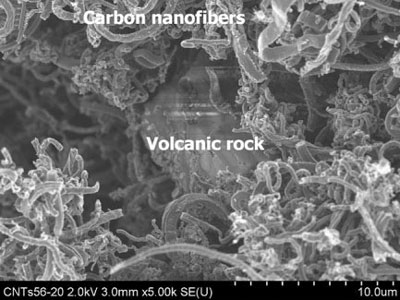
Researchers in Germany have found that the natural nanostructures found in lava rocks are also suitable for making nanomaterials. They are able to stick 1.05 grams of nanocarbons onto 0.2 grams of lava rock - which is amazingly efficient. Lava rocks may be the next big thing in nanotechnology!
Source: Nanotechnology production materials come flowing out of volcanoes

