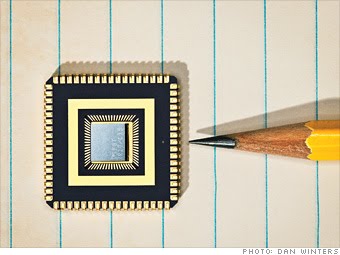
Sensing things around us

For a while there has been talk about distributed sensors. Planting tiny sensors all around to get an idea about what might be going on. Going on with the Earth, maybe predicting earthquakes and things like that. Why distributed? Because this way you don't take a chance on planing one sensor and then picking the wrong spot. HP has taken a step toward distributed sensing by developing the CeNSE network and they are using it to help find oil. These tiny microelectromechanical sensors (MEMS) can detect vibrations. Now they are pretty big but someday scientists hope to make them the size of a pin head.  If you install a few million or billion you can get an idea of what is going on over a large area. The challenge is powering them and then collecting all of the data. But someday they will be installed in everything like buildings, bridges, roads and tell us all about how these things are doing and sensing lots of different things.

Seeing is believing

It was more than 50 years ago that scientists first figured out that DNA was a double helix. Figured out using some indirect measurements like the way X-rays bounced off of DNA and other things like that. Can we see DNA? Sure now with some pretty powerful microscopes. And just recently some scientists in Japan took a look at double stranded DNA and could tell the difference between that and single stranded DNA. The work could have a big impact on things like DNA sequencing.
To learn more go to:
http://tinyurl.com/DNAview

Build your own (not so nano but fun) bot

Everyone wants to be an evil scientist and create their own little nanobot. Well that is hard but building something cool and entertaining with a few parts isn't. The bristle bot is a self-propelled little thing that scoots along the floor. It isn't hard to build and you can find the parts in a lot of different places. The motor is the same one that you find in a cell phone that can vibrate (we don't recommend tearing into a cell phone, especially one that works). This activity was developed by Windell Oskay at Evil Mad Scientist. Check him out. http://www.evilmadscientist.com/article.php?story=bristlebot

Keeping 'em honest

A warning from the International Cycling Union, no nanotech at the Olympic games in London 2012. "At London in 2012 we can guarantee there will be no-one using bikes, equipment and not even clothing (that is illegal) - because we are aware of developments in nanotechnology that can aid athletes in ways that would be outside the rules." said Pat McQuaid, chief of the UCI. Maybe we need to sponsor a nanotech olympics and give out nano gold medals.
http://tinyurl.com/olympicnano

One hair at a time

Little machines, so small they can enter your body and zoom around fixing stuff.  The great scifi classic 'Fantastic Voyage' was all about that, shrinking not just a space ship but all of the folks inside and then zooming around the blood stream.  While that will never happen, building tools so small that they can work inside the body without cutting big holes in you is an important area.  Scientists are building all sorts of devices that will hold and cut and mend small parts in your body.  The big challenge is building them and then powering them.  One way to provide power is to use polymers that respond to heating or some external chemicals.  The polymer changes its shape and causes the parts that the polymer is attached to---in this case the arms of a gripper---to close.  These tiny grippers might be used to grab cancer cells and then bring back samples for analysis.  For more information: http://tinyurl.com/tinycutters

Power up while you boggie

It takes energy to move.  Move to the kitchen, to school, to the couch.  And there is a lot of energy that can be captured from these movements.  Maybe you have a pair of those sneakers with the lights?  They capture the energy from walking and uses it to power a few tiny light bulbs.  Now scientists are trying to take it to the next level by developing more sophisticated nanodevices and make them cheaper.  They use these things called piezoelectric crystals.  Piezoelectric things have been around since the mid-18th century but these new ones are printed and they can be printed onto flexible materials that are also biocompatible.  So maybe you don't want them stitched to the bottom of your feet but perhaps they can be stuck onto a lot of different things making energy for all sorts of devices. No more need to change the battery unless you become a couch potato.
http://tinyurl.com/ygbr3g3
read about the original science http://pubs.acs.org/doi/abs/10.1021/nl903377u

Lab on a stamp

Lab on a chip, how common. How about lab on a stamp. Scientists at Harvard are experimenting with paper as a material for making tiny sensors. Paper is cheap and it turns out it can do a lot of things like separating different molecules. You've probably done some experiments looking at the way colors separate using paper like the one used to make coffee filters. Now add in some inks that are hydrophobic and can be used to direct liquids to different parts of the paper sensor and you are going a long way to make sensors that can test for different diseases. These cheap sensors will have a lot of use in developing countries.http://tiny.cc/w20oj

Nanooze the exhibit opens at EPCOT, Walt Disney World

So it started as a web site, next a magazine and now an exhibit. On February 22, 'Take a Nanooze Break' opened at EPCOT Walt Disney World in Florida. The interactive exhibit has a number of opportunities for guests to explore the nanoworld and get a feel for things that are too small to see.  The exhibit is on long term display located in Innoventions where new science and technology is showcased.  You can sit and listen to stories about nanotechnology, play with a simple to use hand-held microscope, take molecules for a spin and zoom into the nanometer scale structure of a number of different common objects.