calling Nemo

Communicating underwater is tough since sound waves travel differently in water than in air. Researchers at the University of Texas at Dallas have discovered that sheets of carbon nanotubes can act as speakers 100x more effectively than they predicted. The carbon nanotubes are very hydrophobic (meaning they don't like water) so there is a very thin layer of air which helps transmit sound. Maybe in the future you can call up a fish for dinner.
for more information

It's different up there

So nano is different but so is space. Space or more likely microgravity changes a lot of things in addition to drinking and eating and walking around. Scientists have done a lot of experiments in space looking at how cells behave. With more sophisticated tools to study the molecular changes scientists are now discovering just how different things in space are for terrestrial biology. The latest work is using stem cells, those interesting cells in your body that have the ability to form different tissues and bone. They are really important for a lot of therapies to cure diseases such as cancer, diabetes and other stuff. Taking a bit of mouse stem cells into space, scientists discovered that about 64% of the proteins that these cells made in space weren't there when the same cells were grown on the Earth. That is a nanometer kind of change since most proteins are a few nanometers across.  Stem cells are around 10,000 nanometers in size.  One of the scientists, Elizabeth Blaber talked about this work in Houston, Texas at the astrobiology conference. She is a young scientist at the University of New South Wales in Australia working in a field she calls bioastronautics.  Going from Australia to Texas (about 14 trillion nanometers) isn't quite like going into space but a neat opportunity for a young scientist.

Ouch

Getting a shot, a vaccination or something that your doctor uses a needle to give you can hurt. But does it have to hurt? Maybe not according to scientists in Australia.  For a few years now they have been working on something they call the nanopatch.  It has a lot of very small projections (like needles) that help to deliver the vaccine to a special group of cells that helps you develop immunity.  These tiny projections are coated with the vaccine and the patch is applied to your skin.  So far they have tested it on mice but sometime in the near future they should be testing it on humans.  It takes a lot of time for any kind of new medicine or device to be approved for use in humans. That is because there is a lot of safety testing that needs to happen and then proof that it really does work.  It is sometimes frustrating because a great discovery in the lab takes a few years to make it into the clinic.  Even nanotechnology can't make that happen any faster.
http://tinyurl.com/nanopatch

Sensing things around us

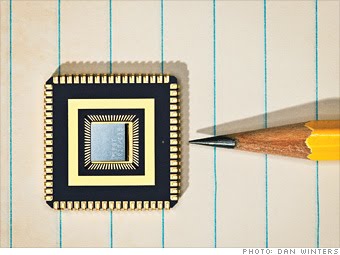
For a while there has been talk about distributed sensors. Planting tiny sensors all around to get an idea about what might be going on. Going on with the Earth, maybe predicting earthquakes and things like that. Why distributed? Because this way you don't take a chance on planing one sensor and then picking the wrong spot. HP has taken a step toward distributed sensing by developing the CeNSE network and they are using it to help find oil. These tiny microelectromechanical sensors (MEMS) can detect vibrations. Now they are pretty big but someday scientists hope to make them the size of a pin head.  If you install a few million or billion you can get an idea of what is going on over a large area. The challenge is powering them and then collecting all of the data. But someday they will be installed in everything like buildings, bridges, roads and tell us all about how these things are doing and sensing lots of different things.

Seeing is believing

It was more than 50 years ago that scientists first figured out that DNA was a double helix. Figured out using some indirect measurements like the way X-rays bounced off of DNA and other things like that. Can we see DNA? Sure now with some pretty powerful microscopes. And just recently some scientists in Japan took a look at double stranded DNA and could tell the difference between that and single stranded DNA. The work could have a big impact on things like DNA sequencing.
To learn more go to:
http://tinyurl.com/DNAview

Build your own (not so nano but fun) bot

Everyone wants to be an evil scientist and create their own little nanobot. Well that is hard but building something cool and entertaining with a few parts isn't. The bristle bot is a self-propelled little thing that scoots along the floor. It isn't hard to build and you can find the parts in a lot of different places. The motor is the same one that you find in a cell phone that can vibrate (we don't recommend tearing into a cell phone, especially one that works). This activity was developed by Windell Oskay at Evil Mad Scientist. Check him out. http://www.evilmadscientist.com/article.php?story=bristlebot

Keeping 'em honest

A warning from the International Cycling Union, no nanotech at the Olympic games in London 2012. "At London in 2012 we can guarantee there will be no-one using bikes, equipment and not even clothing (that is illegal) - because we are aware of developments in nanotechnology that can aid athletes in ways that would be outside the rules." said Pat McQuaid, chief of the UCI. Maybe we need to sponsor a nanotech olympics and give out nano gold medals.
http://tinyurl.com/olympicnano

One hair at a time

Little machines, so small they can enter your body and zoom around fixing stuff.  The great scifi classic 'Fantastic Voyage' was all about that, shrinking not just a space ship but all of the folks inside and then zooming around the blood stream.  While that will never happen, building tools so small that they can work inside the body without cutting big holes in you is an important area.  Scientists are building all sorts of devices that will hold and cut and mend small parts in your body.  The big challenge is building them and then powering them.  One way to provide power is to use polymers that respond to heating or some external chemicals.  The polymer changes its shape and causes the parts that the polymer is attached to---in this case the arms of a gripper---to close.  These tiny grippers might be used to grab cancer cells and then bring back samples for analysis.  For more information: http://tinyurl.com/tinycutters